Airflow Resistance Meter: Accurate Airflow Resistivity Testing for Acoustic and Filtration Materials
June 15, 2026
INTRODUCTION
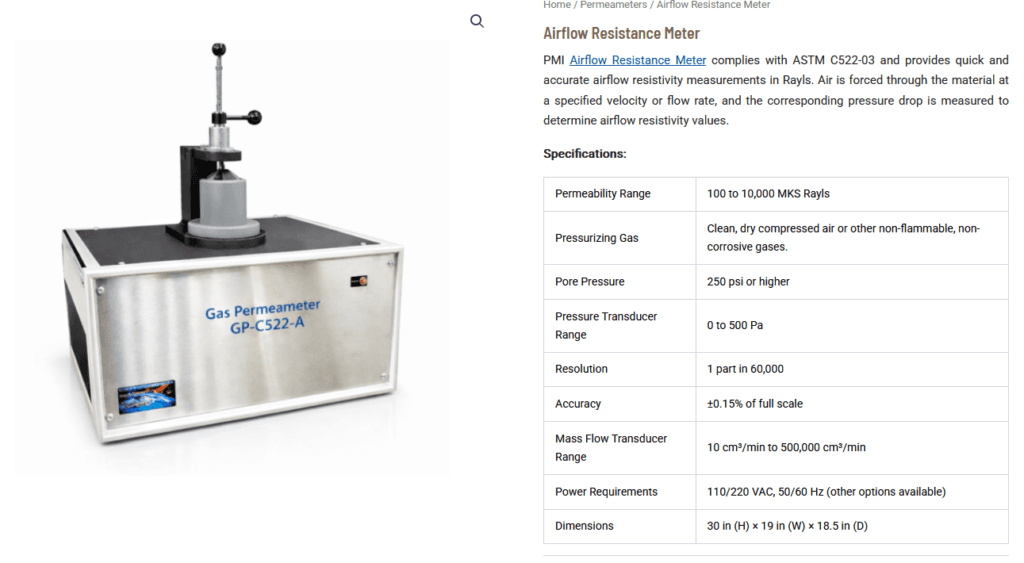
Airflow resistivity measurement is important across sound absorption, air filtration, thermal insulation, automotive, aerospace, and research sectors. The PMI Airflow Meter operates per ASTM C522-03 standards, passing air through samples at controlled speeds while measuring pressure changes. Results display in MKS Rayls units.
WHAT IS AIRFLOW RESISTIVITY?
Airflow resistivity quantifies resistance encountered when air passes through materials. It influences sound absorption, noise blocking, air purification effectiveness, airflow capacity, permeability, energy efficiency, and thermal performance.
IMPORTANCE OF AIRFLOW RESISTANCE TESTING
Manufacturers and researchers conduct airflow testing to verify materials meet design specifications and industry standards, improving acoustic material performance, filtration effectiveness, internal pore analysis, product consistency, research capabilities, and regulatory compliance.
OVERVIEW OF PMI'S AIRFLOW RESISTANCE METER
The system directs air through samples, measures pressure reduction, calculates airflow resistivity values, and reports results in MKS Rayls.
COMPLIANCE WITH ASTM C522-03
The meter meets ASTM C522-03 standards, ensuring standardized testing procedures, reliable data validation, industry-standard methodologies, and quality assurance support.
KEY FEATURES
Wide Measurement Range: Airflow Resistivity Range 100 to 10,000 MKS Rayls
High-Precision Pressure Measurement: Pressure Transducer Range 0 to 500 Pa
Resolution: 1 Part in 60,000
Accuracy: +/-0.15% of Full Scale
Mass Flow Transducer Range: 10 cm3/min to 500,000 cm3/min
Compatible gases: clean, dry compressed air; non-flammable, non-corrosive gases
Pore Pressure: 250 psi or Higher
TECHNICAL SPECIFICATIONS
Airflow Resistivity Range: 100 to 10,000 MKS Rayls
Pressurizing Gas: Clean, Dry Compressed Air or Other Non-Flammable, Non-Corrosive Gases
Pore Pressure: 250 psi or Higher
Pressure Transducer Range: 0 to 500 Pa
Resolution: 1 Part in 60,000
Accuracy: +/-0.15% Full Scale
Mass Flow Range: 10 cm3/min to 500,000 cm3/min
Power Requirements: 110/220 VAC, 50/60 Hz
Dimensions: 30 in (H) x 19 in (W) x 18.5 in (D)
APPLICATIONS
Acoustic Materials (sound foam, soundproof panels, automotive insulation, building acoustic treatment, studio materials), Filtration Media (air filters, HEPA filters, industrial filtration systems, HVAC materials, cleanroom filters), Thermal Insulation Materials (building insulation, industrial insulation, aerospace heat barriers, energy-saving materials), Automotive Industry (cabin sound materials, engine insulation, HVAC systems, noise-reduction components), Aerospace Applications, Research and Development.
CONCLUSION
The PMI Airflow Resistance Meter enables comprehensive assessment of airflow passage through porous materials while maintaining ASTM C522-03 compliance, delivering clear pressure-drop readings, accessible data collection, and stable airflow measurements for acoustic materials, filtration media, insulation, or other porous structures.