Helium Porosimeter: Accurate Porosity Measurement for Rock Core Analysis
June 11, 2026
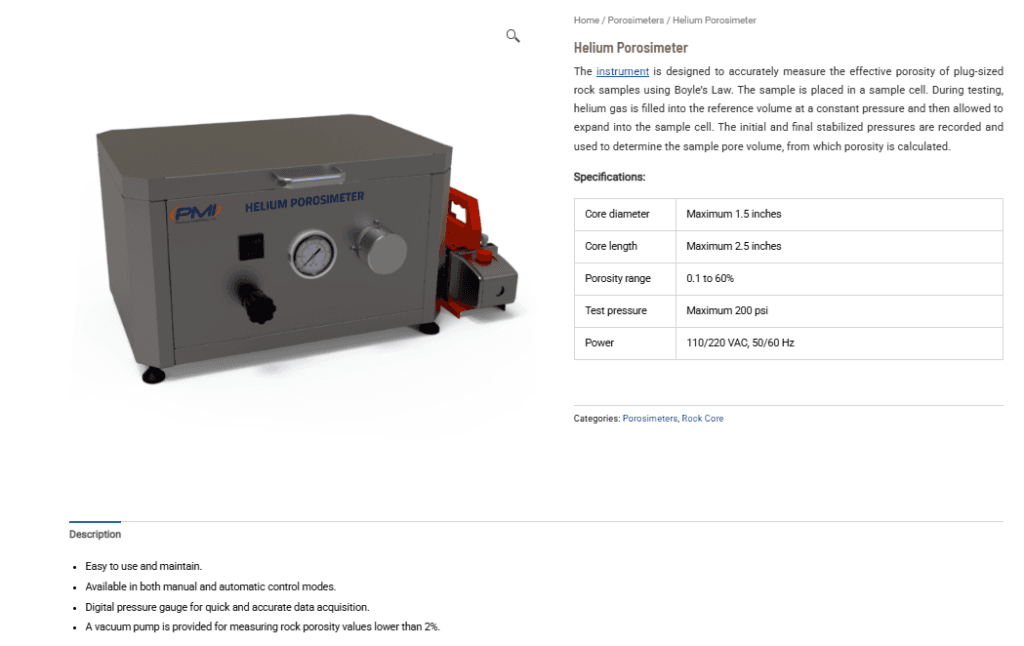
UNDERSTANDING THE IMPORTANCE OF POROSITY MEASUREMENT
Porosity measurement is critical when analyzing oil, gas, rock, and soil samples. The open space within rocks determines how much fluid can be stored or transmitted through them, benefiting petroleum engineering, hydrogeology, carbon storage projects, and geological research. A Helium Porosimeter measures pore space in rock core samples using helium gas and Boyle's Law. "Helium is a very small atom, and it does not react with anything else," enabling penetration into minute rock spaces for reliable porosity data.
WHAT IS A HELIUM POROSIMETER?
This device measures pore space in rock specimens by introducing helium gas into a chamber at controlled pressure. "The gas then moves into the sample chamber," where pressure readings before and after gas migration determine pore volume. Porosity is calculated as a percentage of total rock volume through non-destructive testing.
WORKING PRINCIPLE OF HELIUM POROSIMETRY
Operates using Boyle's Law (inverse relationship between gas pressure and volume at constant temperature). Sequence: place rock core sample in the sample chamber, introduce helium to a reference chamber at set pressure, monitor pressure changes as gas migrates into the sample chamber. "The tool notes down the first and last steady pressures" to calculate grain and pore volumes, with porosity displayed automatically.
KEY FEATURES
High Measurement Accuracy, Manual and Automatic Operation, Digital Pressure Monitoring, Vacuum-Assisted Testing ("A built-in pump helps to measure rock samples. It works with rocks where there is less than 2% porosity"), User-Friendly Design.
TECHNICAL SPECIFICATIONS
Core Diameter: Maximum 1.5 Inches
Core Length: Maximum 2.5 Inches
Porosity Range: 0.1% to 60%
Test Pressure: Maximum 200 PSI
Power Supply: 110/220 VAC, 50/60 Hz
APPLICATIONS
Oil and Gas Industry (reservoir storage capacity, production potential), Core Analysis Laboratories, Academic and Research Institutions, Carbon Capture and Storage (CCS), Groundwater and Environmental Studies.
ADVANTAGES OF USING HELIUM GAS
Chemically inert and stable; small atomic size permits penetration into minute openings; produces reproducible results across multiple rock types while minimizing measurement errors.
CONCLUSION
The Helium Porosimeter measures rock sample porosity using Boyle's Law and helium's unique properties, delivering reliable, fast, non-destructive results used across petroleum engineering, earth sciences, environmental studies, and related fields.