Liquid Extrusion Porosimeter: Safe and Accurate Pore Structure Analysis Without Mercury
June 11, 2026
INTRODUCTION
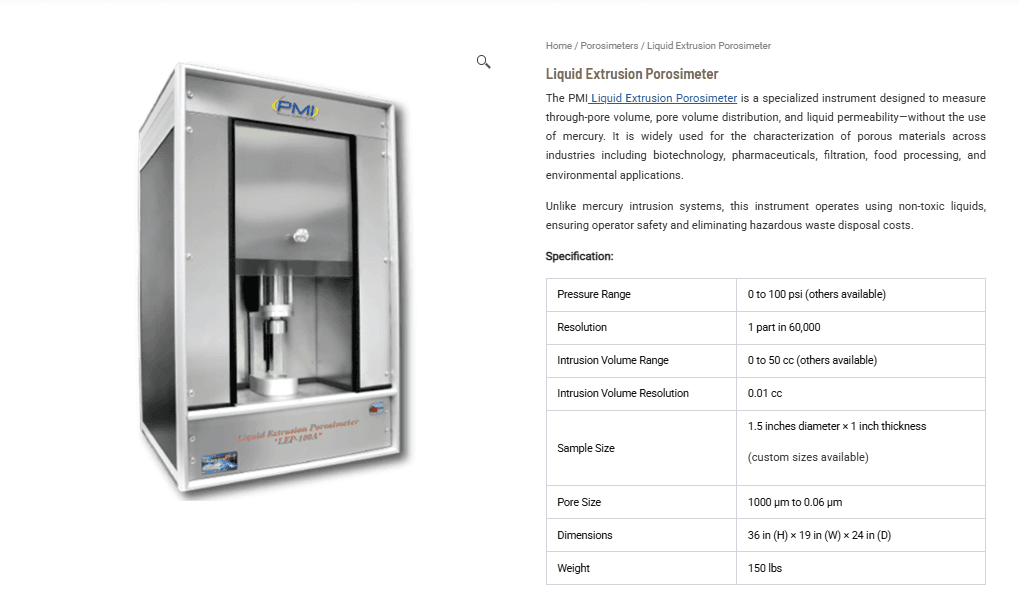
Understanding pore structure is vital across filtration, pharmaceuticals, ceramics, and biotechnology sectors. The Liquid Extrusion Porosimeter provides an environmentally responsible alternative to mercury-based systems, using safe liquids to determine through-pore volume, pore size distribution, and material permeability without health or environmental risks.
WHAT IS A LIQUID EXTRUSION POROSIMETER?
This instrument measures pore dimensions in porous materials by monitoring liquid extraction under applied pressure. It evaluates: through-pore volume, pore size distribution, liquid flow capacity, functional pore structure, material transport properties.
HOW DOES LIQUID EXTRUSION POROSIMETRY WORK?
Testing Procedure: 1) Sample is saturated with liquid; 2) Sample placed in test chamber; 3) Gradual pressure application in increments; 4) Liquid extraction from pores as pressure increases; 5) System quantifies extracted liquid volume; 6) Software analysis determines pore dimensions and permeability. This non-destructive approach preserves sample integrity while generating reliable data.
KEY FEATURES
Mercury-Free Operation, High Measurement Resolution (1 part in 60,000), Wide Pressure Range, Accurate Volume Measurement, Flexible Sample Compatibility, User-Friendly Operation.
TECHNICAL SPECIFICATIONS
Pressure Range: 0 to 100 psi (others available)
Resolution: 1 part in 60,000
Intrusion Volume Range: 0 to 50 cc (others available)
Intrusion Volume Resolution: 0.01 cc
Sample Size: 1.5-inch diameter x 1-inch thickness
Pore Size Range: 1000 um to 0.06 um
Dimensions: 36 in (H) x 19 in (W) x 24 in (D)
Weight: 150 lbs
APPLICATIONS
Filtration Industry (pore characterization, filter performance), Pharmaceutical Manufacturing (tablet porosity, drug delivery evaluation), Biotechnology Research (biological scaffolds, tissue engineering), Food and Beverage Processing (filter material performance), Environmental Engineering (pollution reduction filtration systems), Advanced Materials Research (ceramics, polymers, foams, composites).
ADVANTAGES OVER MERCURY INTRUSION POROSIMETRY
Mercury-free methodology, improved laboratory safety, reduced environmental impact, minimized hazardous waste disposal costs, non-destructive sample analysis, superior result reproducibility, broad material compatibility.
CONCLUSION
The Liquid Extrusion Porosimeter delivers a dependable, secure method for analyzing porous material characteristics, generating pore dimension, permeability, and flow data without mercury-related hazards -- suited to research facilities, industrial laboratories, and QA operations prioritizing safety and regulatory compliance.